
January 14, 2025
Richmond, VA: Industry analyst firm, CIR, has issued a new report covering business opportunities from the new breed of AI data centers over the coming decade. The report, “Networks and Power Requirements for AI Data Centers: A Ten Year Market Forecast and Technology Assessment” says that:
- By 2030 AI data centers built by firms such as Google, Microsoft, OpenAI and others will spend $420 Billion in new networking, storage and server products based on leading-edge technologies such as Ultra Fast Ethernet, Co-packaged Optics (CPO) and Silicon Photonics
- Another $162 Billion will go towards providing electrical power and data center cooling. The expectation is that within a few years much of the power for AI data centers will come from Small Modular (nuclear) Reactors and the cooling will switch from industrial A/C to liquid cooling
This report will be essential reading for networking vendors, service providers, AI software firms, computer companies and investors. To receive samples of this report click here and then click again on the “Request Report Excerpt” box at the bottom of this page.
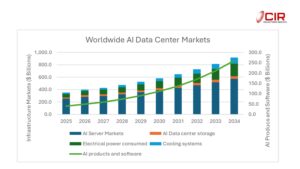
According to CIR’s President and report author, Lawrence Gasman, “Whether AI data centers realize their full revenue generation potential depends on whether latency can be held in check.” He notes that edge networking, high-bandwidth technologies and locating the data centers close to large users all contribute to alleviating latency. “If we can cut through latency issues,” says Gasman then IT, networking and energy-related revenues from AI data centers will reach $915 Billion by 2034.
What do you get when you purchase this report?
- Realism. New revenues for the IT, Networking and Energy sectors will be vast, but threatened by AI hype. In this report, we take a realistic look at how the rise of AI inference and training will impact the data center
- Analysis of the latest products and technologies appearing for AI the data center. The report contains a careful assessment of data center requirements for today’s AI products such as LLMs and Virtual Assistants and how these requirements will evolve as video AI emerges. It also discusses the re-think in the design, layout and equipment choices in data centers to meet the special needs of AI. In addition, we examine the impact of Ultra Ethernet, co-packaged optics and the latest server and storage technology and show how the evolution of GPUs and specialist AI chips change user cases and opportunity spaces
- Detailed projections for analysts and strategists. The forecasts in this report cover: number of data centers by type; AI servers, by port speeds, and networking technology/protocol; data storage for AI data centers; power generation and cooling technology for AI data centers by type of technology
- Insights into vendor strategies. The report provides an insider’s perspective on the strategies and roadmaps of the key influencers in AI data center sector. Coverage include AMD, AWS, Ayar Labs, Broadcom, Cisco, Global Foundries, Google, HPE, Intel, Microsoft, Nokia/Infinera, Meta, NVIDIA, OpenAI, IBM, Oracle, POET, Ranovus, and TSMC. This report also examines who will benefit from the rise of AI data centers in the real estate industry
- User perspectives. The strategic analysis provided in this report is illustrated with user cases showing where the latest IT- and energy-related developments for the AI data center are creating genuine value
About CIR:
CIR has published hype-free industry analysis for optical networking and photonics for more than 35 years. Our reports provide informed and reasoned market forecasts and industry analysis to a global roster of clients. In addition to market analysis reports, CIR provides custom consulting in the areas of networking, quantum technology, and AI. Visit http://www.cir-inc.com for a full listing of CIR’s reports and other services.
Media Contact:
Lawrence Gasman
CIR, Inc.
lawrence@cir-inc.com
(434) 825 1311